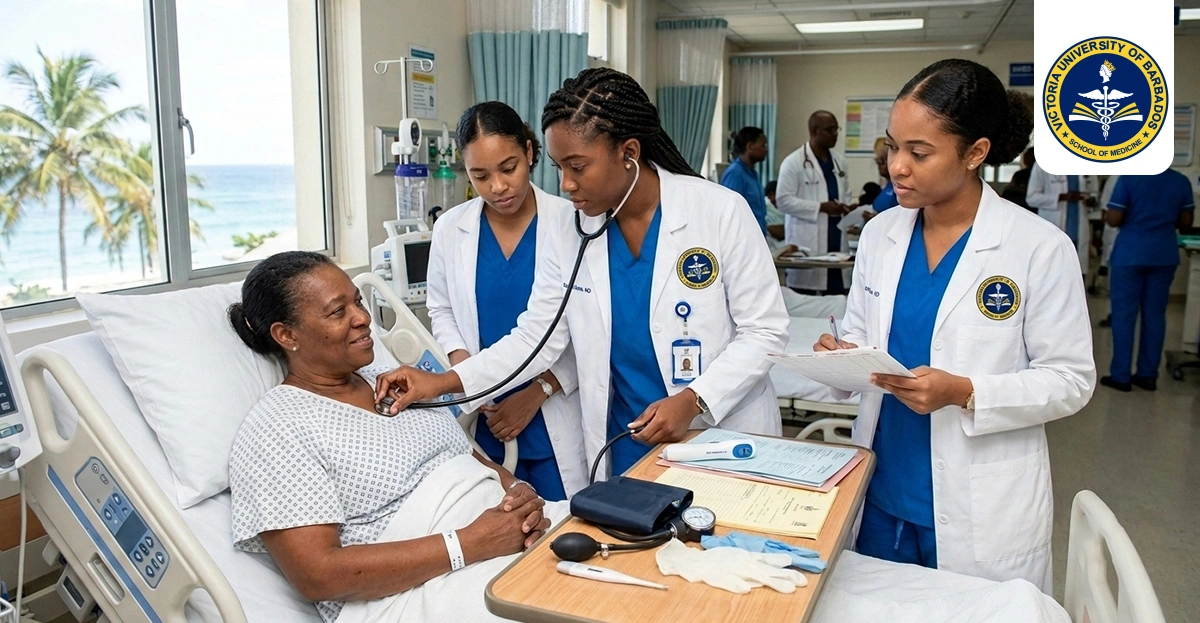
Selecting an MD program is not just about getting theoretical education in the field. Students are also supposed to learn how to put their theories into practice while dealing with patients, analyzing clinical data, communicating with health professionals, and making proper decisions. Clinical training in Barbados can be viewed as a valuable chance for students to combine their learning process with real-life practice.
Victoria University of Barbados (VUB), the clinical stage at the university is focused on practical experience gained via clinical rotations, working with patients, and supervised training. It should be noted that the clinical program at VUB lasts for two years and includes such disciplines as internal medicine, surgery, pediatrics, OB/GYN, and psychiatry.
Students who want to choose an MD in Barbados will definitely benefit from knowing what skills to gain during clinical training.
MD in Barbados marks the point where science gets applied to clinical practice and becomes medicine. Medical students start to acquire practical skills of collecting information, identifying important facts, communicating with patients, and interacting with medical professionals.
VUB notes that the MD training program includes such competencies as taking medical history, conducting physical examinations, evaluating results of laboratory tests, and clinical decision-making.
Besides medical knowledge, medical education institutions today pay increasing attention to other types of competencies. The Association of American Medical Colleges mentions patient care, professionalism, interpersonal and communication skills, practice-based learning, and systems-based practice among the important aspects of undergraduate medical education.
Clinical training in Barbados gives MD students the opportunity to strengthen their practical skills, build confidence with patients, and prepare for real-world medical practice.
A medical student needs to understand how to communicate effectively with patients. Communication entails more than just asking questions.
A medical student is supposed to know how to listen attentively, provide information clearly, and give appropriate answers to the patient. While on clinical rotations, a medical student can enhance his/her communication skills by learning how to:
Some of the competencies that the AAMC highlights include oral communication, empathy, interpersonal skills, and teamwork.
Acquiring knowledge of medical facts constitutes only one component of training to become a physician. It is necessary to know how to integrate symptoms, medical history, findings from physical examinations, and investigations.
Clinical reasoning assists students in developing an approach to patient cases in a systematic manner. While undertaking the MD program in Barbados, it is necessary for the students to take every opportunity arising out of clinical experience to understand the reason for the significance of findings and their impact on management.
Physical examination is still very important in clinical practice. Students need to learn how to conduct physical examinations methodically and in a dignified manner for their patients' sake. During clinical training, students get to learn how to:
Physical examination is among the skills acquired by VUB's MD program.
Medical students are often required to discuss patient information with doctors and other health professionals.
The ideal patient presentation would be well-organised, concise, and clinically relevant. AAMC suggests that a patient presentation involves communication skills along with understanding disease manifestations and therapeutic approaches. Students thus need to practice:
This will prove to be very useful for students as they go through their clinical rotations.
Contemporary medicine requires cooperation of doctors, nurses, pharmacists, therapists, technicians, and many more health care professionals. This is why students must become aware of how to function in a health care team.
Caribbean medical schools provide opportunities for exposure to various health care settings and patients and make adaptability and teamwork an integral part of becoming a professional.
According to the AAMC’s interprofessional education model, communication, role and responsibility, values and ethics, and teamwork are the main aspects of collaboration.
A clinical setting requires the student to show responsibility, respect, confidentiality, honesty, and professionalism.
The VUB MD program, in particular, stresses the following aspects of professional conduct as key components of medical education: the ability to:
Professionalism is not something that one should learn only after graduating. It is something that should be acquired during one's training.
Students can turn clinical exposure into meaningful learning by being active participants rather than passive observers.

Students should also ask supervisors for constructive feedback. The AAMC highlights continuous learning, reflection, feedback, resilience, and adaptability as important professional competencies.
Clinical learning continues even after a rotation is done. Continued development can be achieved through case reviews, reflection on challenging encounters, practicing patient presentations, and identifying areas that require improvement.
Students who wish to study medicine in Barbados will find it helpful to go beyond the scope of what is taught in class and learn about how clinical experience and other forms of practical learning contribute to their medical education.
According to VUB, the university's educational approach involves the combination of medical sciences with practical experiences such as laboratory sessions, seminars, community engagement, and clinical rotations.
The clinical experience provided by Barbados will be useful for MD students in bridging the gap between theoretical knowledge and hands-on practice of medicine. The development of clinical reasoning, communication, examination, teamwork, documentation, professional ethics, and decision-making will assist MD students in becoming competent physicians.
Students considering a Medical School in Barbados will have to take into account the clinical learning environment together with other factors such as curriculum, supervision, clinical rotation, and practical experience. Take a look at VUB's clinical rotation program and MD program.
Clinical training is the practical phase of medical education in which students apply medical knowledge through patient interaction, clinical assessment, case discussions, and supervised healthcare experiences. At VUB, the clinical programme includes exposure to multiple medical specialties.
MD in Barbados: Students should focus on patient communication, history-taking, physical examination, clinical reasoning, patient presentation, teamwork, professionalism, ethics, and continuous learning.
In medical education in Barbados, clear communication helps students interact effectively with patients, families, supervisors, and healthcare teams. It is considered an important competency in modern medical education.
VUB describes its clinical rotations as a two-year programme with exposure to specialties including internal medicine, surgery, pediatrics, obstetrics and gynecology, and psychiatry, with students working under supervision.
Yes. Prospective students should evaluate how a Caribbean medical school structures clinical exposure, supervision, practical learning, and opportunities to develop patient-care competencies alongside classroom education.
Victoria University of Barbados, School of Medicine (VUB) is one of the well-recognized and fastest-growing medical universities in Barbados, North America. Among other recognitions, the University is listed in World Directory of Medical Schools (WDOMS), chartered by Ministry of Education, Science, Technology and Innovation, Government of Barbados, approved by Medical Council of India (MCI), and offers US-Based International-Standard MD Program (equivalent to MBBS).
Know more about The University, MD Program, or contact us for admission inquiries.
Victoria University of Barbados, School of Medicine (VUB) is a well-recognized Caribbean Medical University in Barbados, North America and offers MD Program to aspiring doctors worldwide.