The study of medicine goes beyond just studying subjects like anatomy, physiology, pathology, and others. Students should develop skills that will assist them in communicating with patients, working as part of a healthcare team, analyzing clinical data, and decision-making. Proper development of medical student skills during an MD degree can enable students to feel more ready for their future responsibilities.
At the same time, for those who consider choosing an MD in Barbados, knowing these skills will be able to give them an idea of how to take advantage of their academic, lab, and clinical education. The Victoria University of Barbados defines its MD program as one that involves scientific knowledge, clinical reasoning, practice-based learning, and patient care skills.
The process of medical education entails a shift from theoretical understanding to application of knowledge in a practical setting. The educational process at Victoria University of Barbados involves medical sciences and then clinical training, during which students get an opportunity to interact with various specialties and medical practitioners.
Other competencies for health workers that have been identified by the World Health Organization include person-centered care, decision-making, communication, collaboration, evidence-based practice, and professionalism. For this reason, students need to acquire knowledge as well as practical medical skills.
As you progress through your MD journey in Barbados, building these practical and professional competencies alongside your medical knowledge can help you become a more confident and well-rounded future healthcare professional.
Clinical examination is one of the important methods of patient assessment. The students are supposed to become more familiar with the process of taking medical histories, performing physical examinations, and documenting clinical findings.
Clinical skills are acquired through repeated practice and observation. According to VUB's MD curriculum, history taking, physical examination, testing, and clinical reasoning constitute the training for patient care.
Medical students must learn how to connect symptoms, examination findings and investigation results to possible diagnoses. Clinical reasoning helps students approach patient cases systematically rather than relying only on memorisation.
Strong decision-making is one of the important medical student competencies that develops through case discussions, clinical exposure, and supervised practice.
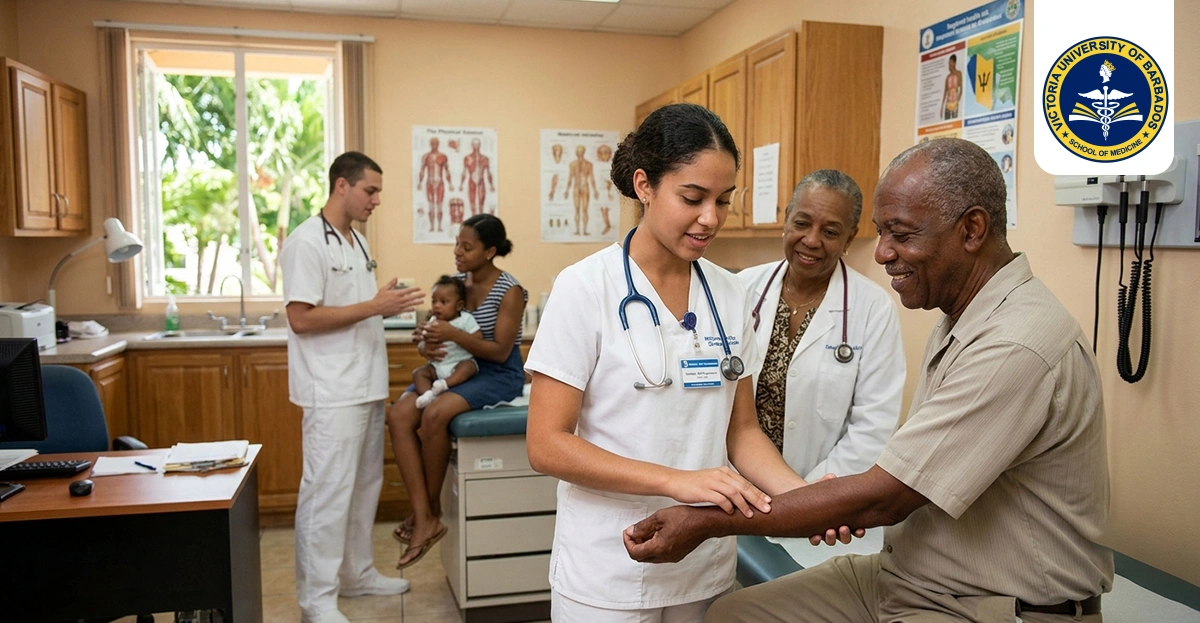
Good physicians must be able to communicate effectively with patients and their family members. Learners must be able to listen attentively, ask proper questions, and explain medical matters to patients in understandable language.
Good patient communication skills include the ability to empathize and demonstrate respect and sensitivity. These qualities are very crucial, especially during difficult diagnosis and treatment discussions.
The healthcare industry is a profession that involves teamwork. Students doing clinical rotations in Barbados have the chance of working alongside doctors, nurses, specialists, and other professionals involved in the health care field.
This can enable the student to learn how to interact as part of the health care team, which in turn allows him/her to comprehend the various professions in health care.
The medical students face difficult cases where a clear solution may not immediately present itself. Critical thinking assists them in analyzing information and identifying relevant evidence while considering different possibilities.
These attributes are helpful not only in exams but even when encountering real-life clinical scenarios. Critical thinking and solving difficult problems from various angles are also emphasized at VUB in their MD program.
Since the field of medicine is evolving, it would be good for students to understand how to seek out, analyze, and use valid medical knowledge.
Understanding the basic principles of research and evidence-based medicine can assist students in making sound judgments. The practice-based learning and improvement component of the MD curriculum at VUB involves seeking out and evaluating medical information.
An MD program may include a combination of lectures, laboratory sessions, examinations, assignments, clinical practice, and self-study, among others. Good time management would make it possible for students to cope with all those obligations without one getting the best of the other.
Such skills could be acquired by planning for practical academic study time and prioritizing key activities.
Professional behavior is a key element in becoming a responsible health care practitioner. They should acquire characteristics such as accountability, integrity, respect, empathy, and compassion.
They must know about confidentiality, ethics in decision-making, and professional behavior. VUB specifically highlights professional behavior, ethical judgment, and respect for patient values in its MD curriculum.
Students studying medicine might come across patients with varied backgrounds, each having varied experiences and expectations as well as requirements. Students must be able to adapt themselves to new situations.
Cultural awareness is an extremely important concept for those international students who are pursuing their studies of medicine in Barbados.
Medical school graduation does not mark the end of a medical education. Continued medical education will be greatly influenced by new medical knowledge, technology, procedures, and standards.
Those students who adopt the practice of continual learning can maintain themselves in a position where they are better prepared for post-graduation professional development. The practice of such thinking can be instilled within the context of an MD program.
By engaging in their learning, students will be able to improve these skills as opposed to concentrating solely on exam preparation. Ways that this can be achieved include:
It involves putting theoretical knowledge into practice. The method is in line with competency-based medical education that focuses on the development of knowledge, skills, and professional attitudes for healthcare delivery.
The development of skills for medical students may ease the process of switching from studies to practical work. Clinical skills, including clinical reasoning, communication, teamwork, professionalism, and evidence-based learning, add up to the scientific knowledge students acquire during the period of their MD studies.
The best strategy for the students who think of getting an MD in Barbados is to take advantage of each class, each experiment, each practical training, and each session of feedback. study medicine in Barbados does not consist of just graduating. It is a matter of acquiring knowledge and skills and forming the right attitude toward one’s profession.
Development of appropriate skills for the medical student in an MD in Barbados will assist in both academic achievement and professional development in the future. Skills such as the clinical exam, communication skills, decision-making, teamwork, critical thinking, research skills, time management, professionalism, adaptability, and lifelong learning are among those that are important.
As a result, students aspiring to pursue a career in medicine in Barbados must do more than perform well in exams and must focus on gaining skills and competencies in their medical training programs.
Interested in exploring your medical education options in Barbados? Visit VUBMED to learn more about the MD journey and available opportunities.
Important skills include clinical examination, clinical reasoning, patient communication, teamwork, critical thinking, research, time management, professionalism, adaptability, and lifelong learning.
Communication skills help future doctors listen to patients, collect relevant information, explain medical conditions, and work effectively with other healthcare professionals.
Yes. Clinical education and supervised practical experiences provide opportunities for students to apply medical knowledge and develop patient-care skills. VUB's clinical rotation program includes exposure to different clinical settings and healthcare professionals.
Evidence-based learning helps students evaluate medical information and apply reliable evidence when developing their clinical knowledge and decision-making abilities.
Victoria University of Barbados, School of Medicine (VUB) is one of the well-recognized and fastest-growing medical universities in Barbados, North America. Among other recognitions, the University is listed in World Directory of Medical Schools (WDOMS), chartered by Ministry of Education, Science, Technology and Innovation, Government of Barbados, approved by Medical Council of India (MCI), and offers US-Based International-Standard MD Program (equivalent to MBBS).
Know more about The University, MD Program, or contact us for admission inquiries.
Victoria University of Barbados, School of Medicine (VUB) is a well-recognized Caribbean Medical University in Barbados, North America and offers MD Program to aspiring doctors worldwide.