Choosing a medical school abroad isn't just about tuition or campus photos; it's about how well medical research in Barbados prepares you for real clinical practice. This is exactly where research opportunities for medical students become a genuine point of difference between programs. At Victoria University of Barbados' MD program, research isn't held back for a token final-year elective; it starts in the earliest lab sessions and builds from there. This article looks at what these opportunities actually involve on the ground, and why they're worth weighing seriously when you compare where to study.
Barbados punches above its weight when it comes to medical research in Barbados. It's a small island with a stable healthcare system, English-medium education, and close academic ties across North America and the wider Caribbean, which means students are exposed to health questions that are genuinely global in scope, from chronic disease management to public health surveillance.
The island also sits inside a real regional research ecosystem. The Caribbean Public Health Agency runs the Caribbean Health Research Conference every year, widely regarded as the largest health research gathering in the English-speaking Caribbean, drawing researchers from across the region's member states. That kind of regional research culture is part of what makes choosing a Caribbean medical school in Barbados different from studying somewhere research is treated as an isolated academic exercise.
Research at the student level looks different depending on where you are in the program.
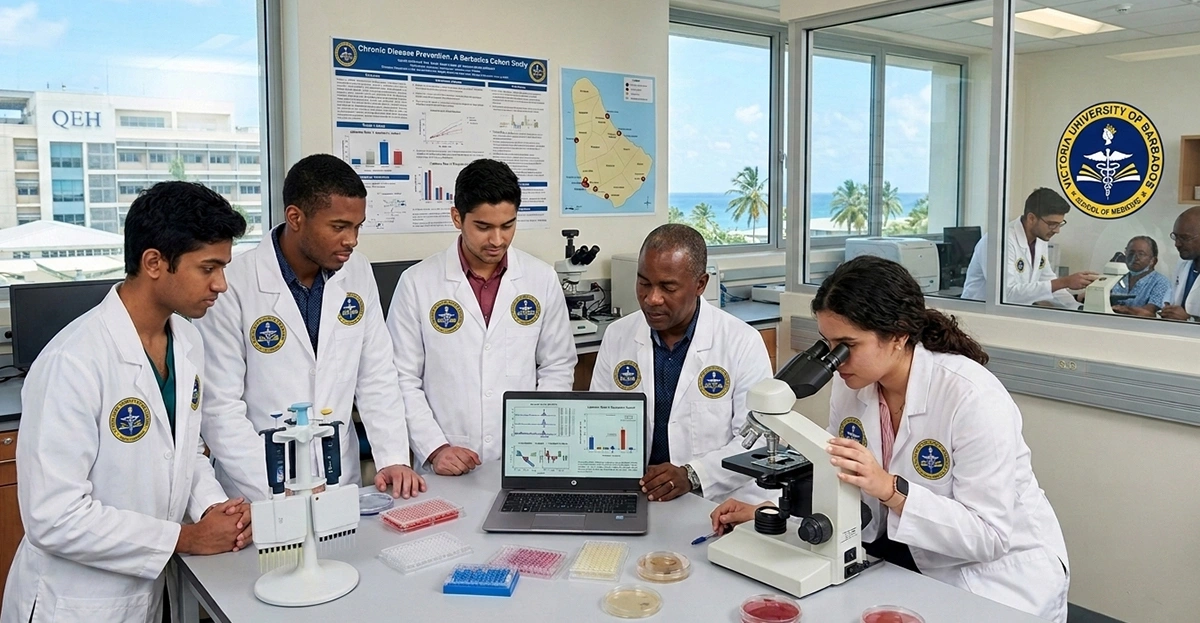
During the foundation and pre-clinical years, coursework in anatomy, physiology, microbiology, and chemistry regularly extends into small, guided lab investigations as part of the pre-clinical program. Designing a simple experiment, collecting data, and interpreting results is a research skill in itself and one that's difficult to pick up from lectures alone.
Barbados' compact size is genuinely useful here. Community health outreach puts students in direct contact with local health data, nutrition habits, chronic disease prevalence, and healthcare access gaps, giving them a chance to work with population-level information that's harder to access as a student in a larger, more anonymous health system.
Once students move into clinical rotations in the fourth and fifth years, research shifts toward case-based work: tracking patient outcomes, contributing to case write-ups, and working alongside physicians who are running their own studies. This is where classroom research skills get tested against real patients.
Students who want to go further can look toward regional research conferences and published case studies as a way to build a track record before graduation, useful whether the eventual goal is a residency match or simply a stronger MD in Barbados on paper and in practice.
Research opportunities for medical students aren't just a line to add to a CV; they shape how a doctor actually thinks. A few concrete reasons this matters:
For Indian students specifically, this matters beyond the degree itself. Practicing in India after an MD in Barbados requires clearing the FMGE screening process, and the analytical habits built through research are the same ones that the exam is designed to test.
Victoria University of Barbados backs this with actual infrastructure, not just intent. The campus includes dedicated anatomy, microbiology, physics, and chemistry labs, a computer lab set up for research and data work, and a library for literature reviews. Faculty, drawn from a range of countries and specialties, guide students through coursework and independent project work.
This matters for anyone who wants to study medicine in Barbados for more than a lecture-hall education. The National Medical Commission also recognizes VUB's MD program and other global bodies, which means the research and clinical training students complete carries weight well beyond the classroom.
Research opportunities for medical students shouldn't be an afterthought when you're comparing where to study; they're one of the clearer signs of how seriously a program takes clinical readiness, not just exam readiness. Between structured lab work, community health projects, clinical-year case studies, and a genuine Caribbean research culture to plug into, Barbados offers more of this than its size might suggest. If that sounds like the kind of MD program you're looking for, it's worth reviewing the MD admission process at VUB to see how it fits your timeline.
Requirements vary by university, but at VUB, hands-on lab work and community health projects are built into the coursework itself rather than offered only as optional extras.
Research isn't a formal FMGE requirement on its own, but the analytical, evidence-based habits it builds directly support exam preparation and later residency applications.
No. Most students arrive with little to no formal research background; programs are built to develop these skills progressively, starting with guided lab work in year one.
Common areas include chronic disease patterns like diabetes and hypertension, infectious disease and public health surveillance, and clinical case studies gathered during rotations, largely shaped by the region's own health priorities.
Victoria University of Barbados, School of Medicine (VUB) is one of the well-recognized and fastest-growing medical universities in Barbados, North America. Among other recognitions, the University is listed in World Directory of Medical Schools (WDOMS), chartered by Ministry of Education, Science, Technology and Innovation, Government of Barbados, approved by Medical Council of India (MCI), and offers US-Based International-Standard MD Program (equivalent to MBBS).
Know more about The University, MD Program, or contact us for admission inquiries.

Victoria University of Barbados, School of Medicine (VUB) is a well-recognized Caribbean Medical University in Barbados, North America and offers MD Program to aspiring doctors worldwide.